
Project · Messaging · Privacy-first
Ryngr
BuiltRyngr is an end-to-end encrypted messaging platform with one-to-one chats, groups, calls, and statuses engineered to feel fast and secure.
01 · Overview
About the project
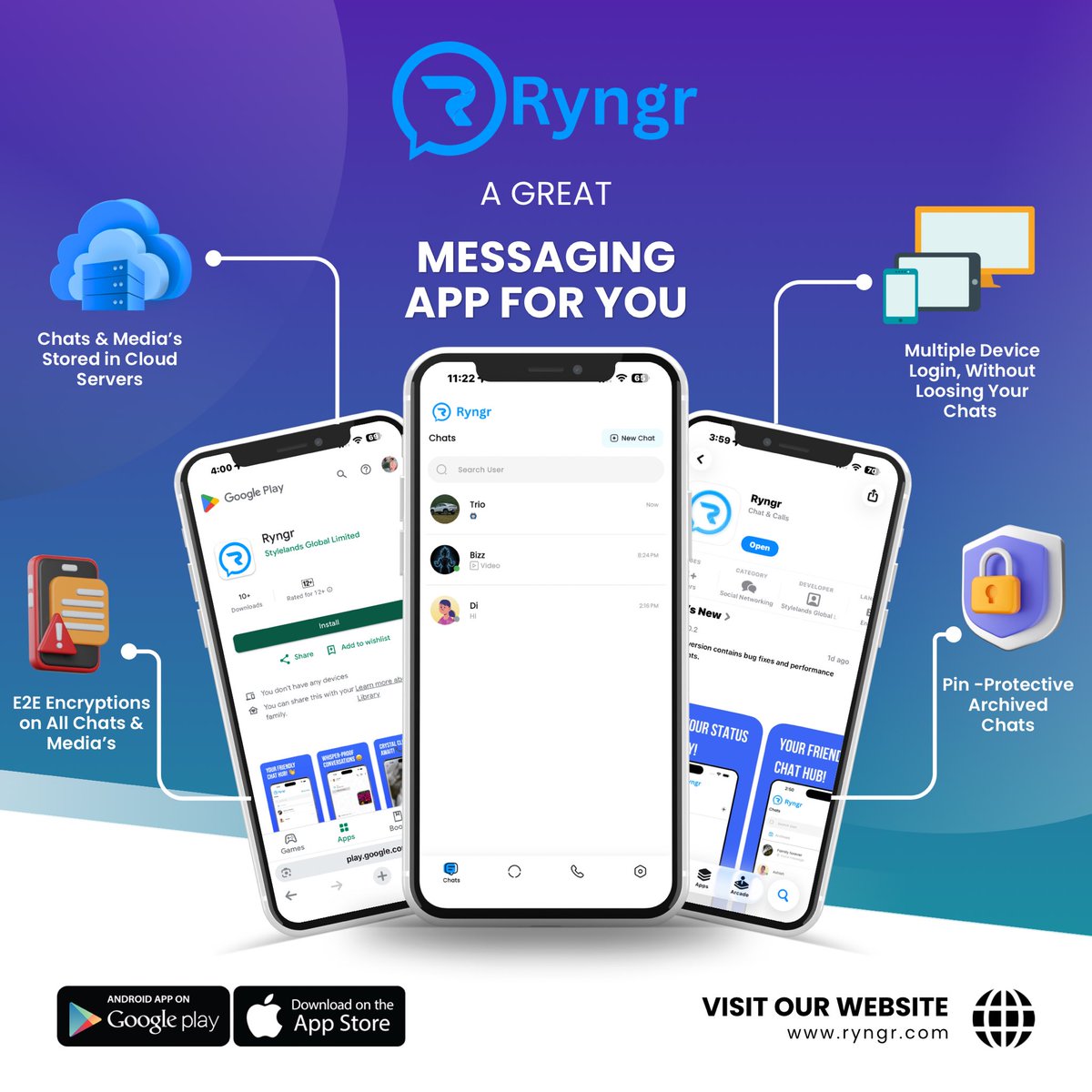
Ryngr is an end-to-end encrypted messaging platform built to combine realtime chat, groups, calls and status updates with a fast, responsive user experience. The platform treats privacy as a baseline constraint — messages are encrypted end-to-end and user identity is handled through a secure authentication pipeline.
The architecture pairs a Flutter mobile client with Node.js backend services, Firebase realtime infrastructure, MySQL relational persistence and serverless cloud functions for event-driven processing.
02 · Problem
What we set out to solve
Messaging apps often trade away privacy features in favor of convenience, while the tools that do promise end-to-end encryption frequently feel slow, heavy or unreliable on everyday networks. Users want 1:1 chats, group conversations, voice/video calls and status updates that feel snappy on real mobile devices without sacrificing the privacy guarantees of proper end-to-end encryption.
Additionally, authentication and account recovery flows on privacy-focused products are often so aggressive that users lock themselves out of their own data permanently, which undermines the actual product value.
03 · My Role
What I worked on
Full stack engineering across the Flutter messaging client, Node.js backend services, secure authentication layer, realtime chat infrastructure and cloud function pipelines. I handled the mobile application architecture, encryption-aware message routing, Firebase realtime channels, MySQL data modeling and the serverless functions that drive notifications and asynchronous work.
04 · Technologies
Stack and how each piece is used
05 · Architecture & Technical Approach
How the system is structured
Ryngr follows a layered REST-native architecture with Node.js backend services exposing authenticated APIs that own user identity, contact relationships, group state and messaging metadata. MySQL serves as the relational system of record, while Firebase handles realtime delivery events, presence indicators and pub/sub-style fanout to connected Flutter clients.
Secure authentication gates every message and call path, ensuring end-to-end encrypted payloads are only routed between authorized participants. Cloud Functions handle notification dispatch and asynchronous side effects outside the request/response path, keeping message submit latency low even when downstream work needs to run.
06 · Key Features
What the product delivers
- End-to-end encrypted one-to-one chat messaging
- Encrypted group conversations with multiple participants
- Voice and video calling support within the app
- Status updates shared with approved contacts
- Secure authentication protecting user identity and session access
- Realtime message delivery engineered to feel fast and responsive
07 · Engineering Challenges
Hard problems we had to solve
- Realtime message delivery with encryption constraints — payloads must stay opaque to the transport while acknowledgements, ordering and retries still work
- Mobile performance for chat lists, media rendering and status carousels while keeping startup and scroll feeling fast on lower-end devices
- Secure end-to-end encryption handling balanced against practical account recovery and multi-device usability
- Call signaling and reliability across varied networks, NAT scenarios and mobile platform background restrictions
- Notification correctness for new messages, call invites and status updates without duplicating or missing events
08 · Solutions
How we addressed them
- Clean architecture with explicit transport, encryption and UI layers; message envelopes stay encrypted across routing while delivery metadata drives acks and retries
- Careful Flutter client optimization with list virtualization, lazy media loading and paginated history fetching for responsive chat performance
- Standardized secure authentication patterns with session management, token refresh and clear boundaries between identity verification and message encryption
- Firebase-powered signaling channels combined with Cloud Functions for reliable offline notifications and async message processing outside the hot path
- Idempotent notification triggers and background delivery patterns ensuring calls, messages and status updates reach users regardless of app state
09 · Outcome
What was delivered
Built and shipped Ryngr as an end-to-end encrypted messaging platform supporting one-to-one chats, groups, calls and statuses across Flutter mobile clients and Node/Firebase backend infrastructure. The product applies clean separation between encryption, transport and UI layers, delivering a fast and responsive messaging experience built on sound engineering foundations.
10 · Lessons Learned
What I'd do differently next time
- Messaging systems live or die by delivery semantics — ordering, acknowledgements, retries and deduplication need to be designed first, not patched around encryption later.
- End-to-end encryption and account usability are in constant tension; the product's threat model needs to be explicit so recovery flows don't silently undermine the privacy promise.
- Real-time products need reliability testing under simulated bad networks more than they need feature work; jitter, drops and reordering expose issues that localhost never will.
Next